

Talk to your business software – as if it were a colleague
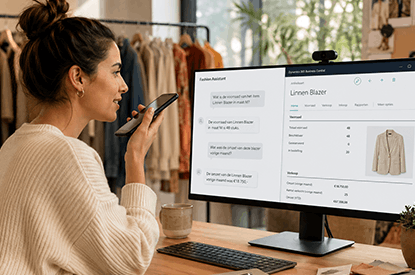
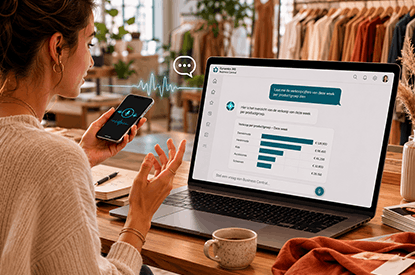
Imagine this: you are a sales manager with an appointment at an important client, and you arrive at the parking lot just a little early. You send a voice message asking for an overview of open sales orders. Moments later, the answer appears on your screen, directly from the ERP system. No login screen, no searching through menus for reports—just ask a simple question and get an immediate answer.
That is no longer a futuristic vision, says Eric van der Craats, Senior Sales Manager at TCOG, specialized in Microsoft-based IT solutions for, among others, the fashion industry. “This is happening now. The technology is here. And for fashion companies that adopt it quickly, the opportunities are enormous.”
 Language as the new interface
An ERP system such as Microsoft Dynamics 365 Business Central is powerful and works with screens, fields, and reports: you navigate to the right section, enter data, and retrieve what you need with just a few clicks. TCOG has been helping fashion companies optimize their systems for years to make them as user-friendly and tailored as possible.
“But now there is an additional layer on top,” says Van der Craats. “AI models such as Claude or Copilot now offer the option to communicate with the ERP system in ‘natural language.’ Ask a question or give an instruction, and the system executes it or provides an answer immediately—without first navigating to the right screen.”
For example, purchasing managers can ask which SS26 styles are underperforming and what the leftover stock risk is. A logistics employee can check the status of a delivery with a simple voice message.
Speed as the competitive advantage
For fashion companies, speed is not a luxury—it is a prerequisite for survival. Collections are launched more rapidly, sales channels are increasing, and consumer behavior is constantly evolving. Van der Craats explains: “Yet many fashion companies do not have their data foundation properly in place: they work with outdated systems or custom solutions that have not been further developed.”
Companies that do have a well-structured ERP landscape can make significant leaps. Integrating with a new sales platform or fulfillment partner used to take months. With AI support, this can be reduced to weeks or even days. AI can also summarize customer conversations and translate them into concrete system configurations. “This allows consultants to spend less time on reporting and more time guiding employees on the shop floor—the truly human part of the job.”
 New channels, new buying behavior
The impact of AI is not limited to internal processes. The way fashion is sold is also changing rapidly. With the recent introduction of TikTok Shop in the Netherlands, e-commerce is shifting further toward social platforms. In other European countries, it has been active for longer, and globally the channel is growing faster than traditional fast fashion platforms—six times faster than Shein.
“The younger generation shops differently,” says Van der Craats. “They are on TikTok, and that is where purchases will soon take place. If you are not there, you are missing a large part of the market.” The purchasing process itself is also evolving. AI assistants are becoming personal shoppers that learn preferences and suggest—or even complete—purchases. This fundamentally changes the question for brands: not only how you sell, but also how you remain relevant in a world where algorithms determine what consumers see.
Humans above machines
Although the technological possibilities and opportunities are enormous, this does not mean everything will be automated. On the contrary, according to Van der Craats, the value shifts toward the human aspect as AI takes over more tasks.
“Attention and intuition remain distinguishing factors—and those cannot be replaced by a machine,” he says. This has long been visible in retail. Stores that stand out do so not only through their products, but through experience, service, identity, and how customers are drawn into their story. Consumers are increasingly willing to pay extra for this. The role of professionals in services is also evolving. Those who use AI for preparation, administration, and reporting free up more time for meaningful conversations—focusing on context, nuance, and relationship management.
From system to conversation partner
What is emerging here is more than software simply becoming smarter. It is a shift in how people work, make decisions, and collaborate with systems. ERP is evolving from a system you need to understand into a system that understands you. And as technology takes over more operational tasks, it becomes ever clearer where humans make the difference: in interpreting data, building relationships, and making decisions.
TCOG is actively experimenting with AI in implementations, customer processes, and data processing—not as a goal in itself, but to help fashion companies become faster, more agile, and future-proof. Van der Craats concludes: “We are moving toward a world where we no longer need to click through countless screens to gain insights into business data. You simply ask a question, and the ERP system answers—as if it were a colleague. Only one that remembers everything and responds instantly, 24/7.”
Questions or need advice on how to make your business more flexible and agile? Contact us for more info!